I've decided to move to Substack. All of my previous posts on Blogger will remain here, but my new posts may be found at:
Monday, October 20, 2025


Saturday, September 06, 2025
Setting the Record Straight: A Reply to John D. Mueller’s Atheism: Pro and Con
In March 2022, John D. Mueller published an essay titled Atheism: Pro and Con at the Ethics & Public Policy Center (EPPC). That piece is framed as a response to version 2 of my draft paper, Do Euthyphro-Style Dilemmas Provide a Decisive Refutation of Theistic Metaethics? (Interested readers may read version 4 of the paper on Academia.edu.) What follows is a clarification of the record and a reply to Mueller’s claims.
1. Context: The History of a 'Discussion' That Never Happened
I uploaded a discussion draft of my paper to Academia.edu, clearly labeled as such and explicitly requesting that it not be cited. Academia.edu notified other users who had expressed an interest in metaethics of the paper and auto-created a "discussion" page linked to it. I recall seeing comments from Mueller and others, but was shocked to discover that Mueller had uploaded his own paper to Academia.edu responding to the discussion draft. Because none of the comments on the discussion page engaged with my essay, I decided to delete the entire discussion page.
Fast forward to today (09/06/2025). I discovered that Mueller republished his “response” on the EPPC site, but added the misleading heading “Jeffery Lowder’s Final Reply.” That section links to the now-deleted Academia discussion page, as though it were evidence of my engagement with him. Readers are left with the impression that I replied to Mueller and then retracted my reply.
That never happened. The only “discussion” was Mueller posting his response on Academia and then later on the EPPC website.
For the record:
-
I never replied to Mueller on Academia.edu.
-
I never posted, and therefore never deleted, any “final reply.”
2. The Euthyphro Dilemma: What Mueller Concedes
Early in his essay, Mueller writes:
“But since Lowder wisely does not endorse Plato’s dilemma as uniformly valid, I confine myself…”
That is a concession. My paper surveys a range of theistic metaethical theories — global divine command theory, modified divine command theory, divine nature theory, and others — and assesses the reach of Euthyphro-style dilemmas against them. I explicitly do not claim the dilemma is a universal refutation. Mueller acknowledges this. Which means: in terms of what my paper actually argues, he registers no disagreement.
3. Naturalism vs Theism: My Debate with Frank Turek
Mueller also links to my 2018 opening statement from a debate with Frank Turek. That statement, now available at Secular Frontier, lays out a structured case for naturalism over theism. In it, I defend three contentions:
-
The best explanation is the one with the greatest balance of intrinsic probability (modesty + coherence) and accuracy (evidential fit).
-
Naturalism is intrinsically more probable than theism.
-
Naturalism is a more accurate explanation than theism, supported by seven evidential lines:
-
Existence of physical reality
-
Success of science without the supernatural
-
Biological evolution (BONES: Biogeography, Organs, Natural selection, Embryology, Stratified fossil record)
-
The biological role and moral randomness of pain and pleasure
-
Mind–brain dependence
-
Neurological bases of empathy and apathy
-
Nonresistant nonbelief
Mueller engage none of these arguments. Instead, he replaces them with a rhetorical “scoreboard”:
“All you have offered is the unsupported and unsupportable assertion that God cannot exist or create a universe because you say so. Let’s review the score:
Time — Universes
(t = 0) — 0
(t > 0) — 1The evidence favors Creation.”
This “scoreboard” bears no resemblance to the Bayesian framework or evidential lines I actually argued. To readers unfamiliar with my work, his summary misrepresents my position. My Euthyphro paper does not claim, presuppose, or even suggest that God “cannot” exist. The person making unsupported claims about what “the evidence” shows is Mueller. To say “The evidence favors Creation” without argument is, in effect, to claim that God exists because he says so.
Because Turek made a similar claim in our debate, here I will simply repeat what I said in rebuttal in that debate:
Turek likes to say: “Atheists think no one created the universe out of nothing, and I don’t have enough faith to believe that.” My reply is simple: I don’t either, which is why I don’t believe that. As physicist Sean Carroll emphasizes, we must distinguish between the Big Bang model (an extraordinarily successful account of the evolution of the universe from very early on) and the Big Bang event (a hypothetical singular moment we know almost nothing about).
Cosmologists can trace the expansion of the universe back to the Planck Era, just after the start of expansion, but what happened at the start of that era remains unknown. Thus, we know that the universe’s expansion had a beginning, but we don’t know whether the universe itself did.
Turek appeals to Einstein’s General Relativity, as if it proved the universe itself had a beginning. But that overstates the case. As Carroll explains:
“The Big Bang [event] is a prediction of general relativity, but singularities where the density is infinitely big are exactly where we expect general relativity to break down—they are outside the theory’s domain of applicability.”
In other words, general relativity describes the universe up to the Planck Era, but not beyond. Using it to infer that the universe itself had a beginning exceeds the theory’s domain.
That is why Mueller’s scoreboard—“at t = 0 there were zero universes, at t > 0 there is one”—doesn’t follow. It assumes precisely what cosmologists caution us against assuming: that the Big Bang event was the absolute beginning of the universe itself.
I have always accepted the data in support of the Big Bang model, but I have never thought it was a "killer" piece of evidence for theism. In fact, I don't think it is evidence for theism at all. I thought that when I was a theist. I thought that when I was an agnostic. And I think that now as an atheist.
4. The Bigger Problem
In both his response to my Euthyphro paper and his comments on my debate opening, Mueller consistently avoids the arguments. He does not address my taxonomy of theistic metaethics. He does not engage the arbitrariness or triviality problems facing divine-command accounts. He does not interact with the Bayesian framework or the seven evidential lines favoring naturalism.
This is particularly disappointing coming from a scholar at the Ethics & Public Policy Center, an institution whose mission is to “apply the riches of the Jewish and Christian traditions to contemporary questions of law, culture, and politics.” Surely, a serious application of those “riches” to the philosophical questions I raise would involve more than rhetoric and sidestepped arguments. Instead, Mueller substitutes autobiographical testimony (“I used to be an atheist”) and the unsupported claim that atheism is “untenable.” That may serve as an apologetic appeal, but it does not qualify as a philosophical rebuttal, nor does it fulfill his institution's stated purpose.
5. Conclusion
Serious debate requires engaging with arguments as they are actually presented, not substituting caricatures or rhetorical flourishes. Mueller concedes my main thesis — that Euthyphro-style dilemmas are not universally decisive — and then changes the subject. When he links to my debate statement, he ignores its arguments and portrays me as offering only an “unsupported assertion.”
That is misleading. Readers who want to see my actual case can read it here: Opening Statement from My Debate with Frank Turek.
I welcome substantive engagement, but engagement means addressing the arguments, not ignoring them and not giving the appearance of a back-and-forth exchange that never took place.
Friday, September 05, 2025
Beyond Euthyphro: The Quadrilemma Against Theistic Grounding of Moral Values
Here's a sketch of an argument against the necessity of God for (objective) moral values.
Consider the following position:
DNT-A: Moral values are grounded in God's nature.
The motivation for this position collapses once we map the logical space of possible grounding relations. Once the options are laid out, it becomes clear: God or God's nature is not required to ground moral values.
The Quadrilemma
If objective moral values exist, their ultimate foundation must be either ungrounded, abstractly grounded, mentally grounded, or physically grounded.
- Ungrounded. Some moral values are fundamental. For example, "kindness is good" is simply a brute, foundational truth.
- Abstract grounding. Some moral values are grounded in other abstract properties or value-relations. For example, the badness of cruelty may be grounded in the disvalue of causing suffering.
- Mental grounding. Some moral values are grounded in a mind or intellect, such as a divine being's valuing activity.
- Physical grounding. Some moral values are grounded in facts about the natural world, such as human flourishing, evolutionary facts about cooperation, or the requirements of well-being.
These four horns are mutually exclusive and jointly exhaustive. There are no further intelligible options for grounding moral values.
Objection: God's Nature is Sui Generis
One might object that the grounding of morality in God is sui generis—a unique, fifth kind of relation not captured by these categories. But is it? To count as a legitimate fifth option, it is not enough simply to assert that it is sui generis. The proponent must explain what this fifth option is and how it differs from physical, mental, and abstract grounding. Unless and until such an account is provided, there is no reason to accept it as a genuine alternative. Therefore, the quadrilemma covers all the intelligible philosophical options.
Why God's Nature Is Not Necessary
Now consider the implications of each horn.
-
Ungrounded: If some values are (ontologically) fundamental, then they do not depend on God by definition. While a theist might respond by proposing God (or His nature) is the ultimate ground of axiology, this view is counterintuitive, less parsimonious, and possibly incoherent.
-
Abstract grounding: If values are grounded in abstract properties like <kindness> or <justice>, it's far more parsimonious to say that they are grounded in abstract properties, full stop, than it is to say “and they are essential properties of God.” Why the middleman? There is no compelling reason to require that moral values be instantiated in God rather than being recognized as foundational abstract properties.
-
Physical grounding: If values are grounded in natural or physical facts, then again God is unnecessary.
-
Mental grounding: If values are grounded in a mind, then God is a candidate. But this option is inconsistent with DNT-A, which says that moral values are grounded in God's nature, not God's mind. Proponents of DNT-A might try to reconcile this with their 'nature' claim by asserting that God's mind and nature are identical. Not only does this move depend on the highly contested and arguably incoherent doctrine of divine simplicity, it still fails to show that God is necessary. The grounding could potentially be in a different sort of mind, making the theistic option one possibility among others, not a requirement.
Beyond Euthyphro
The famous Euthyphro dilemma pressed divine command theory with two horns: are things good because God commands them, or does God command them because they are good? Some thinkers have argued that Modified Divine Command Theory, with its appeal to God’s essentially good nature, shows that the Euthyphro dilemma is a false dilemma.
But the quadrilemma is more difficult to escape. It does not presuppose voluntarism or command theory. It partitions the entire logical space of value grounding. And once the options are on the table, the apologetic claim that (objective) moral values require God can no longer be sustained.
Conclusion
The Quadrilemma Against Theistic Grounding shows that God is never necessary to ground objective moral values. At most, God offers one possible grounding among others. The real question is not whether objective moral values can exist without God. They can. The real question is which grounding theory has the best explanatory virtues, such as parsimony and coherence. On these grounds, non-theistic options appear to have a distinct advantage.
Thursday, May 30, 2024
Finished My Massive Reply to Daniel's Moral Argument for Theism
In order to keep the original URL working, I decided to post updates to the original post rather than make new posts. I am announcing it here for those of you who may not have noticed the updates to the original post.
In my reply, I cover the following topics: purpose, values, standards, duties, freedom, and human dignity.
Enjoy!
Wednesday, May 01, 2024
Schellenberg's Forthcoming Book on the Philosophy of Christianity: "What God Would Have Known"
It is an honor to announce that Mount Saint Vincent University philosopher J.L. Schellenberg has a new book coming out on the philosophy of Christianity: What God Would Have Known: How Human Intellectual and Moral Development Undermines Christian Doctrine (Oxford University Press, 2024).
Schellenberg motivates the need for this book on OUP's website in a provocative blog post entitled, "Has Christian philosophy been having it too easy?" Schellenberg writes:
Oddly—I almost said bizarrely—the past half century has seen no thorough discussion by analytical philosophers of arguments that directly oppose classical Christian ideas about the nature of reality: arguments against, say, Christian ideas about sin or salvation or the divinity of Jesus. And so Christian philosophy has been able to grow and grow and grow without ever encountering a serious challenge to the truth of the doctrine on which it relies.
And so it should come as no surprise that, In What God Would Have Known, Schellenberg scrutinizes the content of the Christian revelation against all of the new information humanity has learned in the many centuries since Christian doctrine was first formed. What sort of new information does Schellenberg have in mind? According to the book's description:
Newly discovered facts, not just about such things as evolution and the formation of the New Testament but also about mental illness, violent punishment, the relations between women and men, and the status of same-sex intimacy, suggest detailed new arguments against the content of the Christian revelation —Schellenberg designs and defends twenty—when the prior understanding of the purported revealer is taken into account.
If this sounds interesting to you, then I have good news. I'm told the book will be available for purchase in the UK at the end of May; it will be available in North America in July. For a limited time, OUP is offering early buyers of the book a 30% discount code if they buy the book directly from OUP. Use the discount code in the image below and then head on over to the book's page at OUP to order.
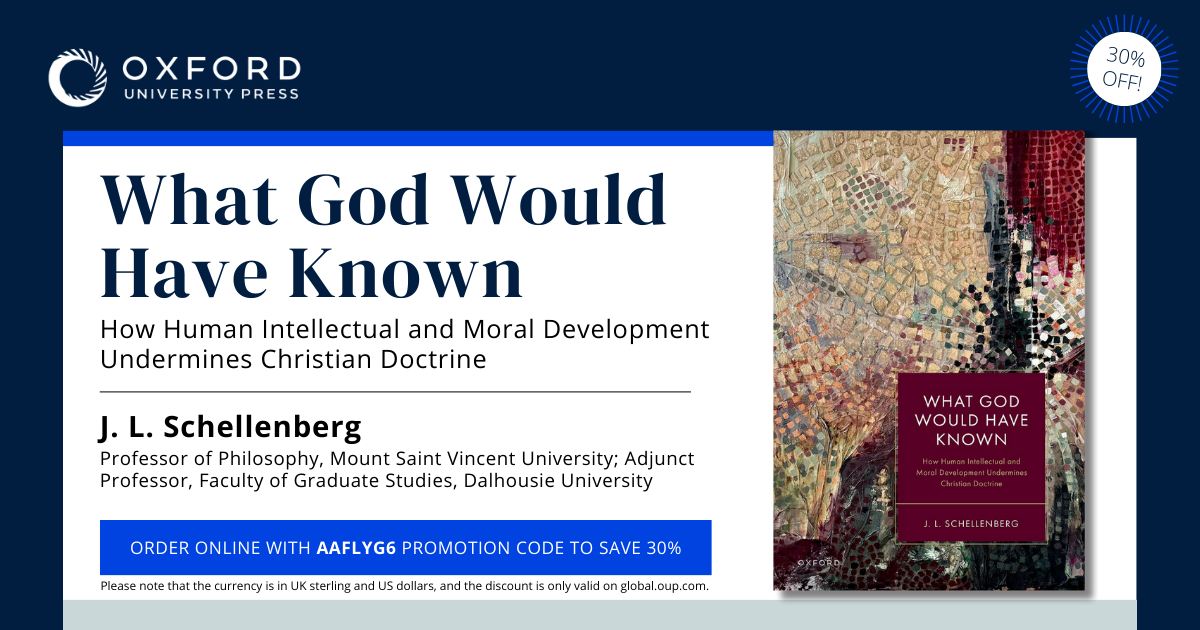
OUP Promotion Code for What God Would Have Known
Source: OUP; License: OUP
LINK to Book at OUP: https://global.oup.com/academic/product/what-god-would-have-known-9780198912323?q=9780198912323&cc=gb&lang=en#
Wednesday, April 03, 2024
Reply to Daniel's Moral Argument for Theism
1. No Good Reason to Think (1) Is True
2. There is Good Reason to Think (1) Is False
2.1. Values
2.2.1. Terminology
2.2.2. Arguments for a Theistic Grounding of Moral Values
2.2.3. Arguments for a Non-Theistic Grounding of Moral Values
2.2. Duties
2.2.1. Exposition
2.2.2. Arguments for a Theistic Grounding of Moral Obligation
2.2.3. Arguments for a Non-Theistic Grounding of Moral Obligation
2.3. Freedom
2.3.1. Terminology
2.3.2. Arguments for the Necessity of Free Will
2.3.3. Arguments against the Necessity of Free Will
2.4. Purpose
2.4.1. Exposition
2.4.2. Arguments for the Necessity of (Agential) Purpose
2.4.3. Arguments against the Necessity of (Agential) Purpose
2.5.1. Exposition
2.5.1.1. General Systems of Ethics
2.5.1.2. "Thin" and "Thick" Moral Standards
2.5.2. Arguments for a Theistic Grounding of Moral Standards
2.5.3. Arguments for a Non-Theistic Grounding of Moral Standards
2.6. Human Dignity
2.6.1. Exposition
2.6.3. Arguments against the Necessity of Dignified Beings
2.6.4. Arguments against Human Exceptionalism
Thursday, September 14, 2023
Index: The Evidential Argument from the Holocaust against Theism
This article will serve as a hub for organizing past and future responses to my evidential argument from the Holocaust against theism.
1: Logical Form of the Argument
The first five steps are a cumulative case based on independent facts about the badness of the Holocaust. Step 1 is an application of Draper's argument from pain and pleasure to the Holocaust; it is defended in the original article.
(1) Naturalism has much more predictive power than Theism does with respect to the biologically gratuitous physical pain experienced by many, if not most, Holocaust victims, i.e.,
Pr(E1 | N) >! Pr(E1 |T).
The next step appeals to the horrendous nature of the Holocaust. I think horrendous evils are much more probable on naturalism than on theism, but that is not the claim I am making here. Because I am making a cumulative case argument, I have to show that each additional item of evidence is more probable on naturalism than on theism, while in effect adding the previous item(s) of evidence into the background information. In probability notation, I need to show Pr(E2 | E1 & N) >! Pr(E2 | E1 & T), not Pr(E2 | N) >! Pr(E2 | T). I defend the former inequality in the original article.
(2) Naturalism has much more predictive power than Theism does with respect to Holocaust victims who experienced and/or witnessed events so horrific that the events constituted prima facie reasons for each victim to doubt whether the victim's life (given their inclusion in the Holocaust) was a great good to the victim on the whole, i.e.,Pr(E2 | E1 & N) >! Pr(E2 | E1 & T).
The third step appeals to a specific aspect of the problem of divine hiddenness, the problem of divine silence during suffering, as it relates to Holocaust victims who experienced biologically gratuitous suffering and horrendous evil. Again, I defend the premise in the original article, but it may be restated in plain English as follows.
(3) Naturalism has much more predictive power than Theism does with respect to the fact that so many victims of the Holocaust did not report feeling God's comforting presence, i.e.,
Pr(E3 | E1 & E2 & N) > Pr(E3 | E1 & E2 & T).
The fourth step appeals to another aspect of the problem of divine hiddenness, this time focusing on what John Schellenberg calls "former believers" and applying it to Holocaust survivors. Again, I defend the premise in the original article, but it may be restated in plain English as follows.
(4) Naturalism has much more predictive power than Theism does with respect to the fact that so many devout Jewish survivors of the Holocaust became nonbelievers, i.e.,Pr(E3 | E1 & E2 & E3 & N) > Pr(E3 | E1 & E2 & E3& T).
From steps 1-4, it follows that:
(5) Naturalism has much more predictive power than Theism does with respect to the Holocaust, i.e., Pr(E | N) >! Pr(E | T).
The next step of the argument is based upon Paul Draper's theory of intrinsic probability, which says that intrinsic probability is determined by modesty, coherence, and nothing else. Because naturalism is both more modest and more coherent than theism, it follows that the intrinsic probability of naturalism is greater than the intrinsic probability of theism. This premise is not defended in my article, but instead may be found in Draper's defense of the second premise in what he calls the "low priors argument."
Using the word "simplicity" as a more concise way to say "has greater intrinsic probability," we get:
(6) Naturalism is much simpler than Theism.
The next step of the argument is designed to preempt objections that other items of evidence (such as the finite age of the universe, the life-permitting conditions of the universe, the contingency of the universe, objective moral values, etc.) favor theism and such items of evidence outweigh the evidence represented by E1-E4. The basic strategy is to show that known facts about good and evil, such as E1-E4, decisively outweigh the theistic evidence. This premise is not defended in my article, but instead may be found in Draper's defense of what he calls the "decisive evidence argument." So the seventh step of the argument is:
(7) Any epistemic advantages that Theism has over Naturalism (i.e., any factors that raise the ratio of the probability of Theism to the probability of Naturalism) do not, even when combined, suffice to offset the epistemic advantages that Naturalism has over Theism if premises 5 and 6 are true.
From steps 5-7, it follows from Bayes' Theorem that:
(8) Theism is probably false.
The two inferences in this argument--the first from 1-4 to 5 and the second from 5-7 to 8--are deductively correct. Therefore, if there is something wrong with this argument, then there must be something with at least if not more of the six premises (1-4, 6-7).2: Non-Objections
I classify a reply as a "non-objection" if it does not constitute a defeater to one or more premises of the argument; and if does not challenge the inference of the argument. What follows is a list of some of the non-objections I have seen.
2.1: Dismissive Replies
- "Why bad thing happen if God real?"
2.2: Confused Replies
- "You don't really have an argument. You made a statement. Actually just a subjective inference."
- "No. It's merely evidence."
2.2: Irrelevant Replies
2.2.1. The Concept of "God"
- Objection: "All this can show is an inconsistency between a particular concept of “God” and that “God” creating the world as you have conceived it."
- Objection: "The argument is presupposed on a false attribution error, i.e., that God's existence is dependent on the absence of suffering. This premise presupposes that God is contingent, rather than necessary; therefore, God is not actually God; because, necessary (i.e., self caused) is an attribute of God. The absence of this attribute, reduces God to the caused, rather than the uncaused causer. Therefore, the argument does not refute the existence of God; instead, it refutes a subjective idea of God predicated on a different set of attributes to those present in God Himself. Argument rejected on the grounds of false attribution error."
2.2.2. Other Replies
- "If God didn’t exist we wouldn’t know the difference between good and evil."
- "Why single out the Holocaust? The "holocaust" could also describe the 10 million murdered under Stalin, or the 170 million murdered under Mao Tse-tung. Nazism was just one of the atrocities of man against man."
3: Objections
3.1: Objections to Multiple Premises
3.2.1: Flip Objections
In interscholastic and intercollegiate debate, to "flip" or "turn" argument is to take one of your opponent's arguments and to use it as an argument for your position and/or against theirs.
Objection: The Holocaust argument presupposes objective (moral) good and evil, but objective (moral) good and evil require God.
Reply: LINK
Objection: The Holocaust argument includes several items in our background information, such as the existence of the universe, conscious beings capable of experiencing pain, and so forth. These things are evidence favoring theism over naturalism.
Reply: First, some items alleged to be theistic evidence, such as the existence of the universe, do not favor theism over naturalism. Second, I agree that at least one fact in our background information, consciousness, favors theism over naturalism. The fact that it favors theism over naturalism does not, by itself, negate the claim that the specific facts identified in the Holocaust argument favor naturalism.
3.2: Objections to Individual Premises
3.2.1: Objections to (1)
3.2.2: Objections to (2)
3.2.3: Objections to (3)
3.2.4: Objections to (4)
3.2.5: Objections to (5)
3.2.6: Objections to (6)
3.2.7: Objections to (7)
Thursday, September 07, 2023
Is It Impossible to Prove Atheism?
(Originally published on 1 September 2023; revised version published on 7 September 2023; revised again on 10 September 2023.)
1: Introduction
“Performative" or "pragmatic inconsistency arguments” attempt to show that some action with respect to some proposition is inconsistent with the proposition. You will sometimes hear people call such propositions “self-defeating,” but that isn’t technically accurate. It isn’t the proposition itself which is self-defeating; it is taking some action with respect to the proposition -- like asserting, believing, or defending it – which is self-defeating. For example, consider the proposition, “It is impossible to know anything.” It is logically possible that the proposition is true, but it is logically inconsistent to know that proposition is true. If you somehow knew that it was true, then you would know that it is false. That’s an example of a performative or pragmatic inconsistency argument.
Here are some other examples of propositions which lend themselves nicely to performative or pragmatic inconsistency arguments:
- "I do not exist."
- "I am dead."
- "I cannot assert or communicate anything."
- "I cannot talk."
- "I don't intend to be understood at all."
All of the above examples involve a first-person ("I") statement, but I'm not sure if a performative or pragmatic inconsistency must be a first-person statement. I'll leave that aside.
2: Exposition
Does atheism involve a pragmatic inconsistency? Before I can discuss this, I first need to define my terms. The word "atheism" is polysemous: it has multiple legitimate meanings. By "metaphysical atheism," I mean the proposition, "God does not exist." By "psychological atheism," I mean the psychological state in which a person lacks the belief that God exists. This post is about metaphysical, not psychological, atheism. For brevity, in the remainder of the post, I will use "atheism" to mean only metaphysical atheism.
According to some thinkers, the action of asserting the truth of atheism is a pragmatic inconsistency. For example, the late Christian philosopher Greg Bahnsen once said:
It's standard fare these days to point out that a universal negative cannot be proven in an a posteriori fashion. On the basis of experience, how could I prove universally there is no God? [...] God might be on the back side of the fourth moon of Jupiter. Since I haven't examined the back side of the fourth moon of Jupiter, it's at least possible that God exists and I haven't encountered him yet. So to say that there is no God is a very strong claim. Atheists usually get hammered about that, that they're claiming too much. In fact, in order to say 'there is no God,' ... you would have to be omniscient. But if you were omniscient, you would be God. Therefore, the only person who could say 'there is no God' is God. God would not deny Himself. So no one can say there is no God.[1]
This suggests the following argument, which I call the "unprovability of universal negatives argument."
(1) The only way to prove a universal negative in an a posteriori fashion is to exhaustively search for all possible sources of evidence of a thing and find no evidence.
(2) But it is impossible for finite, mortal beings to conduct such a search.
Therefore:
(3) It is impossible for finite, mortal beings to prove a universal negative in an a posteriori fashion.
Defenders of the "unprovability of atheism argument" add two additional steps:
(4) The proposition, "God does not exist," is a universal negative.
From (3) and (4), it follows that:
(5) It is impossible for finite, mortal beings to prove, "God does not exist," in an a posteriori fashion.
In the passage quoted above, however, Bahnsen suggests another argument which adds onto the first five steps. Atheism entails that there is no God, but the action of claiming to know that atheism is true presupposes that the person making that assertion has God-like knowledge. So we have:
(6) The action of claiming to know, "God does not exist," presupposes that the speaker is God.
From (5) and (6), it follows that:
(7) If a finite, moral being claims to know, "God does not exist," then it is true that God does not exist and it is false that God does not exist.
From (7) and the Law of Noncontradiction, it follows that:
(8) Any claims made by a finite, mortal being to know, "God does not exist," on an a posteriori basis should not be accepted.
I shall call the inference from (5) - (7) the "pragmatic inconsistency of knowing atheism" argument.
3: Assessment
I shall argue that both the unprovability of atheism argument and the related pragmatic inconsistency of atheism arguments are unsound.
3.1: The Unprovability of Atheism Argument
Here, again, is the unprovability of atheism argument.
(3) It is impossible for finite, mortal beings to prove a universal negative in an a posteriori fashion.
(4) The proposition, "God does not exist," is a universal negative.
Therefore:
(5) It is impossible for finite, mortal beings to prove, "God does not exist," in an a posteriori fashion.
One immediate problem with this argument is its name. From the fact, if it is a fact, that it is impossible for finite, mortal beings to prove atheism in an a posteriori fashion, it does not follow that it is impossible for such beings to prove atheism in a priori fashion. One or more internal inconsistency arguments against God's existence might be sound. But let that pass.
Some philosophers deny the truth of the second premise, (4). For example, in his famous debate with Frank Zindler, William Lane Craig argued as follows.
[...] the statement that God does not exist is not a universal negative; it’s a singular negative statement. Certainly you can prove negative singular statements such as there is no planet between Venus and the Earth. You could provide arguments to show that a singular negative statement is true [...].[2]
Strictly speaking, the first quoted sentence is correct. Categorical propositions are propositions which assert or deny relationships between classes; universal negatives are categorical propositions which have the form, "No S are P." Atheism is not a universal negative in this strict sense. But the statement, "God does not exist," is the same as saying, "No (existing) thing is God." That restatement of atheism is a universal generalization; it is has the form, "There are no S's."[3] Therefore, a proponent of the unprovability of atheism argument might replace "universal negative" with "universal generalization" yielding the following revised version of the "unprovability of universal negatives argument," which gets renamed as the "unprovability of universal generalizations argument."
(1') The only way to prove a universal generalization in an a posteriori fashion is to exhaustively search for all possible sources of evidence of a thing and find no evidence.
(2) But it is impossible for finite, mortal beings to conduct such a search.
Therefore:
(3') It is impossible for finite, mortal beings to prove a universal generalization in an a posteriori fashion.
The "unprovability of atheism argument" would then become:
(4') The proposition, "God does not exist," is a universal generalization.
Therefore:
(5) It is impossible for finite, mortal beings to prove, "God does not exist," in an a posteriori fashion.
The meaning of the word "prove" is ambiguous, but the last two steps of the pragmatic inconsistency argument (steps 6 and 7) provide a clue. That argument targets not atheism, but what is sometimes called "gnostic atheism," the claim to know that God does not exist. This suggests that, at least for Bahnsen, to "prove" a universal generalization means to succeed in demonstrating that belief in the universal generalization can rise to the level of knowledge. So let's revise the first two arguments one more time.
The "unprovability of universal generalizations argument" gets renamed as the "unknowability of universal generalizations argument."
(1'') The only way to reasonably believe a negative universal generalization on an a posteriori basis is to exhaustively search for all possible sources of evidence of a thing and find no evidence.
(2) But it is impossible for finite, mortal beings to conduct such a search.
Therefore:
(3'') It is impossible for finite, mortal beings to reasonably believe a negative universal generalization in an a posteriori fashion.
Likewise, the "unprovability of atheism argument" becomes the "unknowability of atheism argument."
(4') The proposition, "God does not exist," is a negative universal generalization.
Therefore:
(5') It is impossible for finite, mortal beings to reasonably believe, "God does not exist," on an a posteriori basis.
Now consider the first two premises (steps 1'' and 2) in light of this clarification of "prove."
The second premise (step 2) is false. Purely on the basis of experience, one can know that at least some negative universal generalizations are true. Some objects or beings are defined in such a way that, if they exist, they exist at a specific location and at a specific time. For example, consider the title, "Seattle Seahawks Superbowl 60 Most Valuable Player (MVP)." Let "NO SEAHAWKS MVP" refer to the negative universal generalization, "The Seattle Seahawks Superbowl 60 MVP does not exist." If the Seattle Seahawks do not advance to Superbowl 60 (or if they advance but do not win), then NO SEAHAWKS MVP is true: the person described by that title does not exist. In that case, an "exhaustive search" doesn't require superhuman or supernatural abilities. One could reasonably believe NO SEAHAWKS MVP by simply watching Superbowl 60 or reading about it after the fact.
One might object that, even in my highly specified example, the inference to NO SEAHAWKS MVP isn't deductively valid; it is at least possible that there is a global media conspiracy to spread misinformation about the outcome of Superbowl 60, one's sensory organs are defective, or one is literally delusional and imagining sense data not received by one's sensory organs. This objection fails because one does not need absolute certainty to be reasonable in holding a belief. Even if one did not know NO SEAHAWKS MVP, one would still be reasonable in believing NO SEAHAWKS MVP. Contrary to what Bahnsen implies, a person can reasonably believe something they don't claim to know. For the same reason, Bahnsen has not given us a good reason to believe that the first premise (step 1'') is true.
A proponent of the unknowability of atheism argument might grant the above objections and concede that humans can reasonably believe at least some negative universal generalizations, while at the same time insist that there is something special about God such that humans cannot reasonably believe atheism. Here I think it is useful to follow Jeanine Diller in making a distinction between global and local versions of atheism.[4] "Global atheism" is the proposition, "God does not exist," for all concepts of God, including concepts of God which no one has yet even considered. In contrast, "local atheism" is the proposition, "God does not exist," for a specific concept of God. This distinction suggests two further versions of the "unknowability of atheism" argument.
I will call the first of these two versions the "unknowability of global atheism" argument.
(1*) The only way to reasonably believe global atheism on an a posteriori basis is to exhaustively search for all possible sources of evidence of God, for every possible concept of God, and find no evidence.
(2) But it is impossible for finite, mortal beings to conduct such a search.
Therefore:
(5*) It is impossible for finite, mortal beings to reasonably believe global atheism on an a posteriori basis.
The second version, of course, is the "unknowability of local atheism" argument.
(1**) The only way to reasonably believe local atheism on an a posteriori basis is to exhaustively search for all possible sources of evidence of God, for a single concept of God, and find no evidence.
(2) But it is impossible for finite, mortal beings to conduct such a search.
Therefore:
(5**) It is impossible for finite, mortal beings to reasonably believe local atheism on an a posteriori basis.
The first argument is, I believe, much more promising than the second. In light of the fact that there are surely legitimate concepts of "God" which no human has ever conceived, it is difficult to imagine how, on the basis of experience, one could be confident in the belief that all local theisms are false. In other words, in the context of global atheism, the second premise (step 2) seems to be true. Of course, the fact that I cannot conceive of such a justification does not rule out the possibility that one exists. But it seems unlikely that anyone in the year 2023 could reasonably believe global atheism is true. As John Schellenberg has persuasively argued, there are numerous signs of
human intellectual immaturity at the macro level, and we've seen enough evidence of it to say that maturity--the realization (or near realization) of a deep and wide understanding of reality--may yet be a long way off.[5]
Further support for Schellenberg's immaturity hypothesis comes from the work of Paul Draper. In a recent article, Draper explores the conjunction of "merotheism" (God is a proper part of nature) and "monopsychism" (there is exactly one mind or subject of consciousness). He calls this novel version of theism "panpsychotheism" (all-minds-[are]-God-ism).[6] The important point to notice here is that, although some of the greatest minds in history have thought about God, there is no indication that anyone else had thought of this view. All by itself, this single example is evidence that there are other conceptions of God which no one has previously conceived.
In contrast, I think the second argument fails and for essentially the same reason given earlier. At least some God concepts entail or make probable certain states of affairs which be confirmed or disconfirmed by experience. For example, suppose that, in honor of Richard Swinburne, we define a "Swinburne God" as
a being with most of the following properties: being a person without a body (that is, a spirit), present everywhere (that is, omnipresent), the creator of the universe, perfectly free, able to do anything (that is, omnipotent), knowing all things (that is, omniscient), perfectly good, a source of moral obligation, eternal, a necessary being, holy, and worthy of worship. [7]
Let "Swinburnian theism" be the proposition, "The Swinburne God exists." Swinburnian theism clearly entails other propositions; one does not need to know that one of those entailments is false in order to reasonably believe that one of those entailments (and, by extension, Swinburnian theism itself) is false.[8] This is why I think the second premise (step 2) of the "unknowability of local atheism" argument fails.
3.2: The Pragmatic Inconsistency of Believing Atheism Argument
In the last section, we saw that the unprovability of atheism argument is not successful, but can be at least partially repaired by transforming it into the unknowability of atheism argument. The conclusion of that argument is:
(5') It is impossible for finite, mortal beings to reasonably believe, "God does not exist," on an a posteriori basis.
Defenders of the pragmatic inconsistency argument should then revise the last three steps as follows.
(6') The action of reasonably believing, "God does not exist," presupposes that the speaker is God.
From (5') and (6'), it follows that:
(7') If a finite, mortal being reasonably believes, "God does not exist," on an a posteriori basis then it is true that God does not exist and it is false that God does not exist.
From (7') and the Law of Noncontradiction, it follows that:
(8') It is impossible for a finite, mortal being to reasonably believe, "God does not exist," on an a posteriori basis.
This argument fails for two reasons. First, its second premise, (6'), is false. Even if it is impossible for finite, mortal beings to reasonably believe atheism on an a posteriori basis, it does not follow that it is impossible for such beings to reasonably believe atheism on an a priori basis. One does not have to be omniscient in order to know, much less reasonably believe, that there is a successful a priori argument for local atheism.
For example, here is one schema for what I call an "internal inconsistency argument" for local atheism.
(9) If God existed, then He would have property P1.(10) If God existed, then He would have property P2.(11) Any being with property P1 would have some further property P3.(12) Any being with property P2 would not have property P3.(13) Therefore, it is impossible for any being to have properties P1 and P2. (from 11 and 12)(14) Hence, it is impossible for God to exist. (from 9, 10 and 13)
The basic idea is to show that if God existed, then he would have two properties P1 and P2. The next step is to show that property P1 entails some third property P3, while property P2 entails the denial of property P3. Since it is impossible for any being both to have and not have P3, it follows that that being cannot exist. While it might or might not be the case that there are no successful arguments of this type for local atheism, it really doesn't matter one way or the other for the purpose of this post. The speaker does not need to be omniscient in order to know the truth of (9) - (12).
Second, the argument's conclusion, (8'), does not follow from (5') - (7'). (6') refers to the action of claiming to reasonably believe, "God does not exist," but does not specify that that knowledge is based upon an a posteriori basis.
As with the unknowability of atheism argument, let us now consider two versions of the pragmatic inconsistency argument based on the distinction between global and local atheism. The global version can be summarized as follows:
(5*) It is impossible for finite, mortal beings to reasonably believe global atheism on an a posteriori basis.
(6*) The action of reasonably believing global atheism presupposes that the speaker is God.
Therefore:
(7*) If a finite, mortal being reasonably believes global atheism on an a posteriori basis, then global atheism is true and global atheism is false.
Therefore:
(8*) It is impossible for a finite, mortal being to reasonably believe global atheism on an a posteriori basis.
There are two problems with this argument. The first is that it is invalid: (6*) refers to the action of claiming to reasonably believe global atheism but does not specify that that knowledge is based upon an a posteriori basis. It seems to me that this objection could be avoided by revising the argument again as follows:
(5**) It is impossible for finite, mortal beings to reasonably believe global atheism.
(6**) The action of reasonably believing global atheism presupposes that the speaker is God.
Therefore:
(7**) If a finite, mortal being reasonably believes global atheism, then global atheism is true and global atheism is false.
Therefore:
(8**) It is impossible for a finite, mortal being to reasonably believe global atheism.
That solves the problem identified by the first objection, but brings into sharper focus the second objection. Even if we assume that premise (5**) can be adequately defended, premise (6**) does not seem to be true. If premise (5**) is true, then it seems that the action of claiming to reasonably believe global atheism presupposes that the speaker has knowledge which greatly exceeds that of any human being in history. But "has knowledge which greatly exceeds that of any human being in history" is not a sufficient condition for being God. First, it's far from obvious that such knowledge requires omniscience, and many conceptions of God posit an omniscient being, not just a really smart being. Second, even if the speaker's actions did presuppose that the speaker is omniscient, being omniscient is not a sufficient condition for being God. It is at least conceivable that there exists an omniscient being which does not have any of the other attributes typically associated with God, such as omnipotence, moral perfection, eternity, aseity, sovereignty, immutability, necessity, etc.
I don't know how Bahnsen would respond to this objection. Perhaps Bahnsen could show that the speaker's actions require such a superhuman degree of knowledge that the speaker's actions presuppose that the speaker is not necessarily God, but at least a supernatural being. Since metaphysical naturalism rules out the existence of any supernatural beings, not just God, the argument could then be transformed into a pragmatic inconsistency argument against believing metaphysical naturalism.
Now consider the local version of the pragmatic inconsistency argument, which can be summarized as follows:
(5#) It is impossible for finite, mortal beings to reasonably believe local atheism on an a posteriori basis.
(6#) The action of reasonably believing local atheism presupposes that the speaker is God.
Therefore:
(7#) If a finite, mortal being reasonably believes global atheism on an a posteriori basis, then global atheism is true and global atheism is false.
Therefore:
(8#) It is impossible for a finite, mortal being to reasonably believe local atheism on an a posteriori basis.
This argument suffers from the same defects as its global counterpart. Unlike the global pragmatic inconsistency argument, however, I am doubtful that the second premise, in this case (6#), can be repaired by replacing "God" with "supernatural being." For ordinary human knowledge is all that is needed to reasonably believe that some local theisms are false. Thus, the action of claiming to reasonably believe local atheism does not appear to be a pragmatic inconsistency, at least not in any sense related to the issues discussed in this post.
4: Conclusion
In this post, I have considered two arguments: the unprovability of atheism argument and the pragmatic inconsistency of knowing atheism argument. The unprovability of atheism argument is best and most charitably understood as the unknowability of atheism argument, which has two versions. The unknowability of global atheism argument seems promising, but the unknowability of local atheism argument fails. For at least some concepts of "God," one can reasonably believe that local atheism is true. Finally, the pragmatic inconsistency argument fails because one does not need to be superhuman, much less omniscient, in order to reasonably believe the truth of the premises of an internal inconsistency argument. Perhaps there is a successful global pragmatic inconsistency argument (against the action of believing naturalism), but the local pragmatic inconsistency argument seems hopeless.[9]
Notes
[1] “Michael Martin Under the Microscope” audiocassette, tape 3.
[2] William Lane Craig, “Second Rebuttal Speech” Atheism vs. Christianity (January 1993), https://www.reasonablefaith.org/media/debates/atheism-vs.-christianity
[3] Thanks to Paul Draper for helping me to see this clearly.
[4] Diller, J. "Global and local atheisms." Int J Philos Relig 79, 7–18 (2016). https://doi.org/10.1007/s11153-015-9550-1
[5] J.L. Schellenberg, Progressive Atheism: How Moral Evolution Changes the God Debate (New York: Bloombsury, 2019), p. 50.
[6] Paul Draper, "Panpsychotheism." In Current Controversies in Philosophy of Religion (New York: Routledge, 1990), pp. 160-177.
[7] Richard Swinburne, The Coherence of Theism (2nd ed., New York: Oxford University Press, 2016), p. 1.
[8] For an example of such an argument, see Paul Draper's formulation and defense of his "Decisive Evidence Argument" in Draper, Paul, "Atheism and Agnosticism", The Stanford Encyclopedia of Philosophy (Summer 2022 Edition), Edward N. Zalta (ed.), URL = <https://plato.stanford.edu/archives/sum2022/entries/atheism-agnosticism/>.
[9] Thanks to Paul Draper for some very helpful conversations which significantly improved the quality of this post. Any errors are, of course, solely my responsibility.
Saturday, August 19, 2023
The Columbine Mass Shooting and the Myth of Cassie Bernall's Martyrdom
Mark D. Linville has published a short booklet with Ravi Zacharias International Ministries (RZIM) entitled, "Is Everything Permitted? Moral Values in a World Without God?" The booklet begins with the following statement by Linville:
Few news stories have had the profound effect on me as did the shooting rampage at Columbine High School.
Can you guess where this is headed? Linville continues:
Friday, August 18, 2023
More on Plantinga, Atheism, and Moral Obligation
Today I remembered Plantinga wrote a very interesting article on naturalism and obligation back in 2010 in the journal Faith and Philosophy. I just checked my archives and made an interesting discovery. First, that article reinforces my belief that Plantinga believes atheism (and, indeed, naturalism) and moral obligation are incompatible. Second, in that article, Plantinga explicitly says he is not going to argue directly for that incompatibility claim; rather, he intends to "display" the failure of the most natural way of arguing that naturalism can accommodate moral obligation. In his own words:
I propose to support the claim that naturalism cannot accommodate morality—not by showing directly that it can’t, but by displaying the failure of the most natural way of arguing that it can.
Imagine how Plantinga would have reacted if Mackie said, "I'm not going to directly argue for the claim that God and evil are incompatible. Rather, I'm going to indirectly argue for it by displaying the failure of the most natural way of arguing that God and evil are compatible." Surely Plantinga would have replied: "Even if Mackie succeeds at that task, that still falls short of what he needs to defend his logical argument from evil: a rigorous defense of the claim that God and evil are incompatible." And Plantinga would have been right.
By similar reasoning, then, it seems to me that the Autonomous Morality Defender ("Defender") would be just as correct to use a parallel reply to Plantinga. Even if Plantinga's article succeeds in showing that the "most natural way of arguing that" naturalism can "accommodate morality" fails, Plantinga would still fall short of what he needs to defend his 'logical' argument from morality for theism.
Wednesday, August 16, 2023
Can We Show There is No Inconsistency between Atheism and Moral Obligation?
In a prior post, I showed that Plantinga has failed to demonstrate a contradiction between atheism and moral obligation in any of this three types of contradiction: explicit, formal, or implicit. I want to continue to my exploration of the alleged contradiction between atheism and moral obligation, this time by asking if we can show that there is no inconsistency between atheism and moral obligation.
In the spirit of maximal transparency, what follows is mostly plagiarized material from Plantinga's book, God, Freedom, and Evil, Part I, Section a, sub-section 3, with the obvious exception that I have edited the material referring to God and evil with my own material referring to atheism and moral obligation.
Assessing the Resurrection Hypothesis: McCullagh, Craig, Cavin, and Colombetti
In this post, I want to consider the assessment of historical hypotheses such as the alleged resurrection of Jesus (R), using the writings of William Lane Craig as a foil. In doing so, I will rely heavily upon a recent article by philosophers Robert Greg Cavin and Carolos Colombetti, but I want to be clear that I have not reviewed this post with them, so any mistakes in this post are entirely my responsibility.
While Craig's position regarding the use of Bayes' Theorem has evolved over the years, to my knowledge one thing which has not changed is his reliance upon the work of historian C. Behan McCullagh.[1] Following McCullagh, Craig argues for R using an argument pattern called "inference to the best explanation" (IBE).[2] In this post, I will argue the following three points contra Craig. First, Bayes' Theorem is the foundation for logically correct arguments for any historical hypotheses. Second, neither McCullagh's IBE criteria nor Craig's restatement of them are sufficiently clear to enable a rigorous assessment of historical hypotheses, whereas the Bayesian approach avoids these problems. Third, Craig's defense of R fails to establish that the alleged event is more probable than not.
Friday, August 11, 2023
Is the Combination of Atheism and Moral Obligation a Contradiction?

An Impossible (or Penrose) Triangle
Three Types of Contradictions
Writing in 1955, the late Oxford don J.L. Mackie claimed that evil is logically inconsistent with God’s existence.
In its simplest form the problem is this: God is omnipotent; God is wholly good; and yet evil exists. There seems to be some contradiction between these three propositions, so that if any two of them were true the third would be false. But at the same time all three are essential parts of most theological positions: the theologian, it seems, at once must adhere and cannot consistently adhere to all three.[1]
Consider the following set of propositions: {God is omnipotent; God is wholly good; evil exists}. Mackie claimed that the set is somehow contradictory. But how?
Thursday, August 10, 2023
Pro-God Atheism
For many former theists-turned-atheists, the loss of belief in God is a source of sadness. Consider these words from Christian-turned-atheist philosopher J.L. Schellenberg, taken from the conclusion of his landmark book, Divine Hiddenness and Human Reason (Cornell University Press, 1993).

P.S. Now ask yourself: how often do you find atheist-turned-theist philosophers writing a book defending some argument for God's existence, such that the book's conclusion expresses the hope that other people will be able to refute his or her argument for God?
Wednesday, August 09, 2023
Atheism and the Laws of Logic
Daniel (@DarwinToJesus) recently tweeted the following:
#1. The laws of logic: There are three basic foundational laws of logic.
— Daniel (@darwintojesus) April 23, 2023
1. The law of identity (A* is A*)
2. The law of non contradiction (A* is not/cannot be B* in the same place and time)
3. The law of the excluded middle (every proposition is either true, or false)
These…
Monday, August 07, 2023
Theistic vs. Naturalistic Grounding of Moral Value

Seth Dillon, the CEO of The Babylon Bee, recently tweeted the following:
Sure, atheists have moral values — they just can't ground them in anything. Read Alex Rosenberg's "The Atheist's Guide to Reality." He acknowledges that in God's absence, morality is nothing but a useful fiction. He argues that if atheism is true, the moral feelings we've… https://t.co/HSufKX5ay5
— Seth Dillon (@SethDillon) August 7, 2023
Sunday, August 06, 2023
New Paper Refuting Anscombe's "Modern Moral Philosophy"
 |
 |
| Terence Irwin | Elizabeth Anscombe |
Irwin, T. The Philosophy and History of the Moral ‘Ought’: Some of Anscombe’s Objections. Ethic Theory Moral Prac (2023). https://doi.org/10.1007/s10677-023-10398-w
Abstract: According to G.E.M Anscombe’s paper ‘Modern Moral Philosophy’, modern moral philosophy has introduced a spurious concept of moral obligation, and has therefore made a mistake that the Greeks, and Aristotle in particular, avoided. Anscombe argues that the modern concepts of obligation, duty, and the moral ‘ought’ are the remnants of an earlier, but post-Aristotelian conception of ethics, and that they ought to be abandoned. An examination of Anscombe’s historical and philosophical claims shows that we have no reason to take them seriously. In particular, they rest on a misinterpretation of Scholastic views on ‘ought’ and obligation.
Tuesday, August 01, 2023
The Pragmatic Inconsistency of Responding to Nihilism with Despair

(1) Necessarily, if metaethical nihilism is true, then nothing matters.
(2) Responding with despair to the (supposed) truth of metaethical nihilism presupposes the falsity of metaethical nihilism.
Therefore:
(3) If one responds with despair to the (supposed) truth of metaethical nihilism, then it is true that nothing matters and it is false that nothing matters. [From 1-2]
Therefore:
(4) It is impossible to consistently respond with despair to metaethical nihilism. [From 3 and LNC]
They key insight of this argument is that if metaethical nihilism is true, then literally nothing, including metaethical nihilism itself, matters.
Thursday, July 27, 2023
Draft Essay: Naturalism, Theism, Badness, and Moral Law: A Critique of Ravi Zacharias

Overview:
1: Introduction
2: Logical Arguments from Evil
(a) Historical Context
(b) Zacharias's Framing of the Problem of Evil
3: Zacharias's "Work of God" Theodicy
4: Changing the Subject: Morality Without God
(a) Do Atheists Who Run An Argument from 'Evil' Contradict Themselves?
(b) Quote-Mining Atheists Who Reject Objective Morality
(c) Bogus Appeals to Authority Aside, Do Russell, Mackie, and Dawkins Have Good Arguments?
Subscribe to:
Posts (Atom)