Showing posts with label philosophy of religion. Show all posts

Wednesday, May 01, 2024

Schellenberg's Forthcoming Book on the Philosophy of Christianity: "What God Would Have Known"

It is an honor to announce that Mount Saint Vincent University philosopher J.L. Schellenberg has a new book coming out on the philosophy of Christianity: What God Would Have Known: How Human Intellectual and Moral Development Undermines Christian Doctrine (Oxford University Press, 2024). 

Schellenberg motivates the need for this book on OUP's website in a provocative blog post entitled, "Has Christian philosophy been having it too easy?" Schellenberg writes:

Oddly—I almost said bizarrely—the past half century has seen no thorough discussion by analytical philosophers of arguments that directly oppose classical Christian ideas about the nature of reality: arguments against, say, Christian ideas about sin or salvation or the divinity of Jesus. And so Christian philosophy has been able to grow and grow and grow without ever encountering a serious challenge to the truth of the doctrine on which it relies.

And so it should come as no surprise that, In What God Would Have Known, Schellenberg scrutinizes the content of the Christian revelation against all of the new information humanity has learned in the many centuries since Christian doctrine was first formed. What sort of new information does Schellenberg have in mind? According to the book's description:

Newly discovered facts, not just about such things as evolution and the formation of the New Testament but also about mental illness, violent punishment, the relations between women and men, and the status of same-sex intimacy, suggest detailed new arguments against the content of the Christian revelation —Schellenberg designs and defends twenty—when the prior understanding of the purported revealer is taken into account.

If this sounds interesting to you, then I have good news. I'm told the book will be available for purchase in the UK at the end of May; it will be available in North America in July. For a limited time, OUP is offering early buyers of the book a 30% discount code if they buy the book directly from OUP. Use the discount code in the image below and then head on over to the book's page at OUP to order.
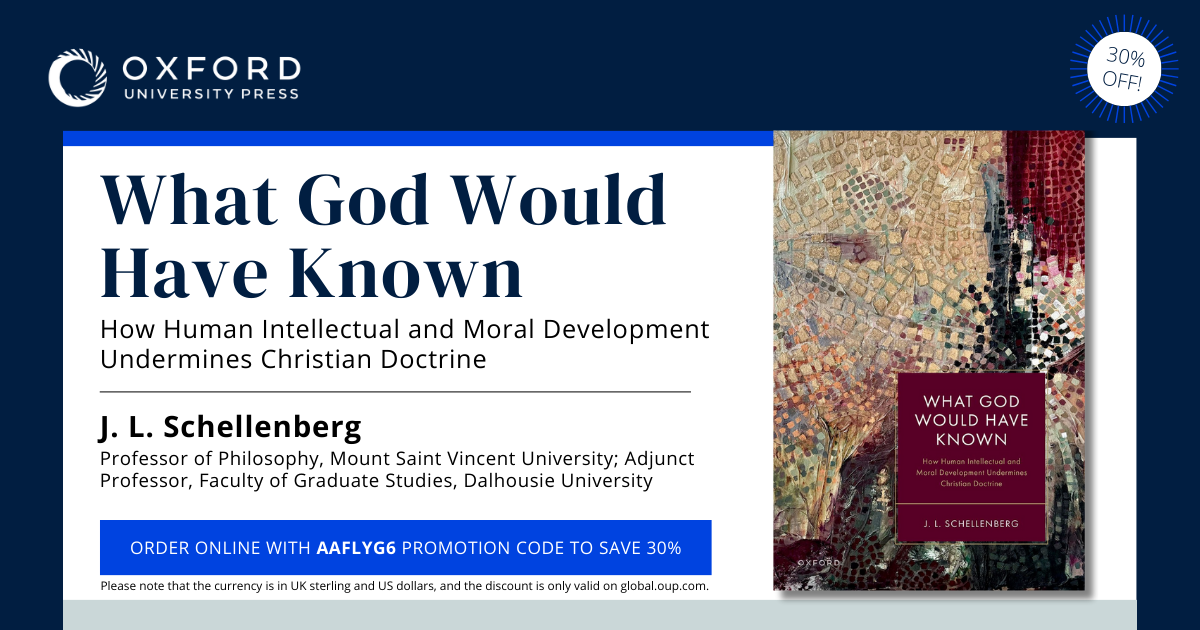


OUP Promotion Code for What God Would Have Known
Source: OUP; License: OUP

LINK to Book at OUP: https://global.oup.com/academic/product/what-god-would-have-known-9780198912323?q=9780198912323&cc=gb&lang=en#

Sunday, November 07, 2021

Link: The Metaphilosophy of Naturalism

Abstract: The metaphilosophy of naturalism is about the nature and goals of naturalist philosophy. A real or hypothetical person who knows the nature, goals and consequences of naturalist philosophy may be called an “informed naturalist.” An informed naturalist is justified in drawing certain conclusions about the current state of naturalism and the research program that naturalist philosophers ought to undertake. One conclusion is that the great majority of naturalist philosophers have an unjustified belief that naturalism is true and an unjustified belief that theism (or supernaturalism) is false. I explain this epistemic situation in this paper. I also articulate the goals an informed naturalist would recommend to remedy this situation. These goals, for the most part, have as their consequence the restoring of naturalism to its original state (approximately, to a certain degree, given the great difference in the specific theories), which is the state it possessed in Greco-Roman philosophy before naturalism was “overwhelmed” in the Middle Ages, beginning with Augustine (naturalism had critics as far back as Xenophanes, sixth century B.C.E., but it was not “overwhelmed” until much later). Contemporary naturalists still accept, unwittingly, the redefinition of naturalism that began to be constructed by theists in the fifth century C.E. and that underpins our basic world-view today.

Friday, October 28, 2011

LINK: From Friendly Atheism to Friendly Natural Theology

[This post was originally published on The Secular Outpost on October 19, 2011. It was republished here on November 8, 2021 with the date manually adjusted to reflect its original publication date. The link was also updated to its current location.]

Jeffery Johnson, "From Friendly Atheism to Friendly Natural Theology: The Case for Modesty in Religious Epistemology" Minerva - An Internet Journal of Philosophy Vol. 7 2003.


Abstract

Philosophical theists argue with great ingenuity and sophistication that there is excellent evidence in support of the existence of the God of western theism. Philosophical atheists argue with equal skill that the evidence is negative. Both sides can't be right. But, this seems to imply that one camp is guilty of serious epistemological error. I explore in this essay a way of understanding good theological evidence that mitigates charges of intellectual error or blindness. According to a position that Rowe calls friendly atheism, the atheist can argue that the relevant evidence supports his or her view, but that theists are rationally justified in believing that God exists in spite of the intense suffering that manifest in this world. I will argue that friendly atheism, and more generally friendly natural theology, when articulated in more detail, and with great care, represents an important metaphilosophical insight about use of evidence in theological contexts.

LINK

Friday, October 21, 2011

Catalog of Bayesian Arguments in Philosophy of Religion

[This post was originally published on The Secular Outpost on October 21, 2011. It was republished here on November 8, 2021 with the date manually adjusted to reflect its original publication date. The link was also updated to its current location.]

I've created a new page, with a permanent link near the top of the screen, to a catalog of Bayesian arguments in the philosophy of religion, including Bayesian arguments for and against God's existence. This is a work-in-progress, so please leave a comment on that page to let me know of any additions, edits, etc. I need to make.