Showing posts with label J.L. Schellenberg. Show all posts

Wednesday, May 01, 2024

Schellenberg's Forthcoming Book on the Philosophy of Christianity: "What God Would Have Known"

It is an honor to announce that Mount Saint Vincent University philosopher J.L. Schellenberg has a new book coming out on the philosophy of Christianity: What God Would Have Known: How Human Intellectual and Moral Development Undermines Christian Doctrine (Oxford University Press, 2024). 

Schellenberg motivates the need for this book on OUP's website in a provocative blog post entitled, "Has Christian philosophy been having it too easy?" Schellenberg writes:

Oddly—I almost said bizarrely—the past half century has seen no thorough discussion by analytical philosophers of arguments that directly oppose classical Christian ideas about the nature of reality: arguments against, say, Christian ideas about sin or salvation or the divinity of Jesus. And so Christian philosophy has been able to grow and grow and grow without ever encountering a serious challenge to the truth of the doctrine on which it relies.

And so it should come as no surprise that, In What God Would Have Known, Schellenberg scrutinizes the content of the Christian revelation against all of the new information humanity has learned in the many centuries since Christian doctrine was first formed. What sort of new information does Schellenberg have in mind? According to the book's description:

Newly discovered facts, not just about such things as evolution and the formation of the New Testament but also about mental illness, violent punishment, the relations between women and men, and the status of same-sex intimacy, suggest detailed new arguments against the content of the Christian revelation —Schellenberg designs and defends twenty—when the prior understanding of the purported revealer is taken into account.

If this sounds interesting to you, then I have good news. I'm told the book will be available for purchase in the UK at the end of May; it will be available in North America in July. For a limited time, OUP is offering early buyers of the book a 30% discount code if they buy the book directly from OUP. Use the discount code in the image below and then head on over to the book's page at OUP to order.
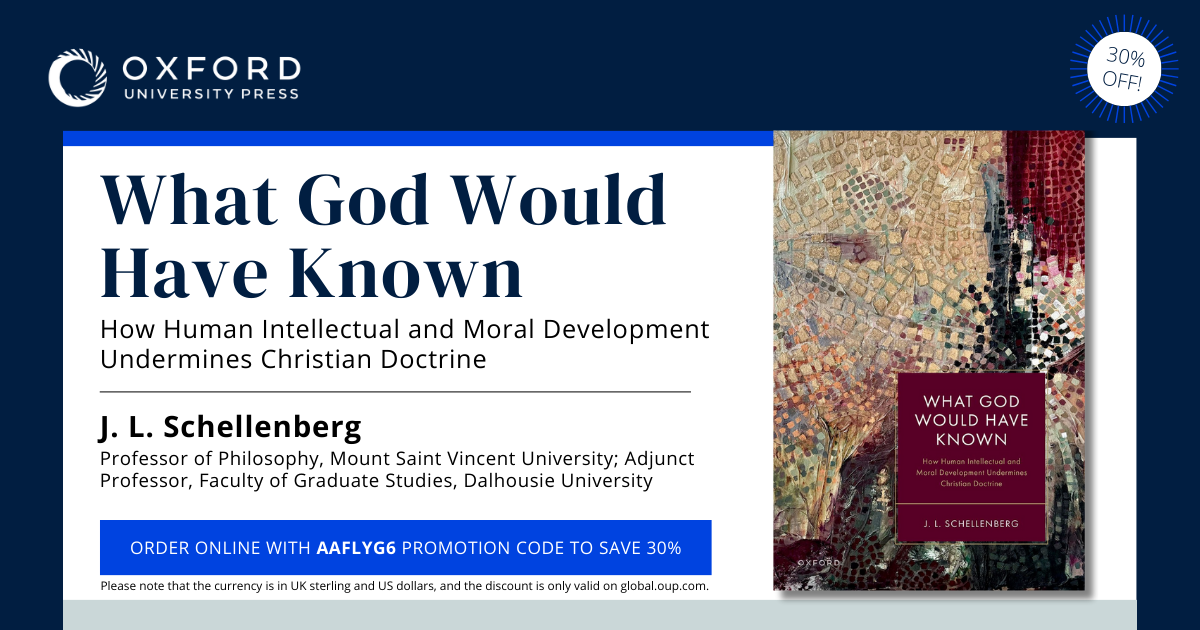


OUP Promotion Code for What God Would Have Known
Source: OUP; License: OUP

LINK to Book at OUP: https://global.oup.com/academic/product/what-god-would-have-known-9780198912323?q=9780198912323&cc=gb&lang=en#

Thursday, August 10, 2023

Pro-God Atheism

For many former theists-turned-atheists, the loss of belief in God is a source of sadness. Consider these words from Christian-turned-atheist philosopher J.L. Schellenberg, taken from the conclusion of his landmark book, Divine Hiddenness and Human Reason (Cornell University Press, 1993).


P.S. Now ask yourself: how often do you find atheist-turned-theist philosophers writing a book defending some argument for God's existence, such that the book's conclusion expresses the hope that other people will be able to refute his or her argument for God?


Tuesday, November 09, 2021

LINK: Bruce Langtry's Reply to Schellenberg's Logical Argument from Evil for Atheism

(Note: Although I am technically on hiatus from blogging for 1-3 years, while clearing out my inbox I came across an email about this article, so I'm mentioning it here.)

Abstract

J. L. Schellenberg, in “A New Logical Problem of Evil,” argues that (if God exists) God has, of necessity, a disappreciation of evil, operating at a metalevel in such a way as to give God a non-defeasible reason to rule out actualizing a world containing evil. He also argues that since God’s motive in creating the world is to share with finite beings the good that God experiences prior to creation, which is good without evil, it follows that God will create a world that contains no evil. I investigate in detail the foregoing lines of argument and provide grounds for rejecting them.

Sunday, October 16, 2011

LINK: Schellenberg's Review of The Cambridge Companion to Atheism

[This post was originally published on The Secular Outpost on October 16, 2011. It was republished here on November 8, 2021 with the date manually adjusted to reflect its original publication date.]

J.L. Schellenberg is arguably one of the leading philosophers of religion in the world and, among other things, the philosopher who formulated the argument from divine hiddenness for atheism. Schellenberg reviewed The Cambridge Companion to Atheism (ed. Michael Martin) in the Notre Dame Philosophical Reviews.

Here is the conclusion of Schellenberg's review:

I myself think that a good case for atheism (understood as disbelief of traditional theism) can be developed, but the arguments in this book leave one with the impression that the case is weaker than it is, and it must be said that the available arguments for theism are stronger than they are here suggested to be. Still, the student or nonspecialist will be able to take away from both the philosophical and the nonphilosophical discussions that this work contains a pretty good idea of which issues are important to the understanding and assessment of atheism, and should be stimulated — if only through disagreement — to think more carefully about those issues for herself. 

LINK